AI Agents in Enterprise: How Will They Change the Way We Work?
mini传媒 VP of AI, Kathy Pham, explores AI agents and their influence on the workplace, alongside practical guidance for leaders.
Kathy Pham
Vice President, Artificial Intelligence
mini传媒
mini传媒 VP of AI, Kathy Pham, explores AI agents and their influence on the workplace, alongside practical guidance for leaders.
Kathy Pham
Vice President, Artificial Intelligence
mini传媒
As AI systems become more sophisticated—capable of learning, memory, and acting independently to complete tasks—we are presented with new opportunities to enhance how work gets done within our organizations, especially our understanding of individual roles, their specific tasks, and how to personalize experiences.
We conducted a global study revealing that 83% of professionals familiar with AI believe it will augment human capabilities, leading to increased productivity and new forms of economic value. This sentiment underscores a growing recognition that the future of work lies in how we use AI to elevate human potential.
One of the most exciting aspects is the evolution of agentic AI, commonly referred to as AI agents. In this article, we dive into AI agents, exploring what they are, how they’re reshaping the future of work, and how leaders should be thinking about leveraging them in their organizations.
Let’s start by defining AI agents. AI agents are systems that perceive details of the surrounding environment, process and reason the next steps, and execute on those steps to achieve specific goals. They can even learn from their experiences, storing those learnings in memory to improve future iterations.
This technology allows us to move beyond analyzing data and making predictions to executing tasks autonomously, combining agents and people to fulfill complex processes. It enables enterprise technology to anticipate user needs and proactively completes tasks.
For users of enterprise systems, this means a simple, personalized experience. Behind the scenes, AI agents break down complex processes, consider individual context, and coordinate tasks to solve challenging business problems. This level of personalization is unprecedented, adapting to user expertise and specific organizational needs. These capabilities empower us to unlock solutions never before possible.
We conducted a global study revealing that 83% of professionals familiar with AI believe it will augment human capabilities, leading to increased productivity and new forms of economic value.
Guide
AI agents are poised to change everything from customer service and supply chain management to HR and finance. The key is to understand their potential and develop a strategic roadmap for implementation.
Here are a few examples of how they can address common business challenges:
Deploying AI agents successfully requires careful planning and execution. Here are some high-level considerations to keep in mind:
By keeping these points in mind, companies can successfully use AI agents while ensuring responsible and ethical deployment.
AI agents are poised to change everything from customer service and supply chain management to HR and finance.
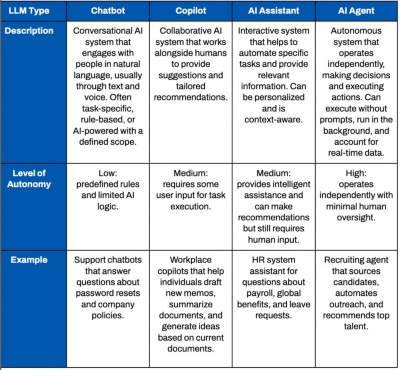
Before we explore the different types of AI agents, let’s understand what sets them apart from other large language models (LLMs). The evolution of AI agents has been driven by the rapid advancement of LLMs in recent years. LLMs have paved the way for increasingly sophisticated AI capabilities, from basic chatbots to AI assistants, copilots, and now a new frontier ofAI agents.
AI agents have been in development since the 1960s, encompassing a wide range of capabilities. Understanding different types of agents can help determine how to incorporate them to solve specific business challenges. A few are listed below:
Reactive agents: These are the simplest type of AI agents, operating on a set of predefined rules. They react to specific situations based on those rules, but they don't learn or adapt over time. Think of a chatbot that provides pre-written responses to common questions.
Model-based agents: These agents have a "model" of their environment, allowing them to predict the consequences of their actions and make more informed decisions. For example, a model-based agent in a retail setting might predict future demand for a product based on historical sales data and current market trends.
Goal-based agents: These agents are driven by specific goals. They plan and execute actions to achieve those goals, even if it requires multiple steps or adapting to changing circumstances. A goal-based agent might be used to optimize a marketing campaign, adjusting strategies in real-time to maximize conversions.
Utility-based agents: These agents go beyond simply achieving goals; they aim to maximize a specific "utility function," which could represent customer satisfaction, cost efficiency, or any other measurable outcome. For example, a utility-based agent in healthcare might create treatment plans that optimize patient outcomes while minimizing costs.
Learning agents: These agents are the most sophisticated type, capable of learning and adapting over time. They use machine learning algorithms to analyze data, identify patterns, and improve their performance. A learning agent might be used to personalize customer recommendations, continuously refining its suggestions based on user feedback and behavior.
Collaborative agents: These agents work together to achieve shared goals, communicating and coordinating their actions to solve complex problems. For example, collaborative agents might be used to optimize traffic flow in a city, with each agent controlling a specific intersection and communicating with its neighbors to minimize congestion.
Task-based agents: These agents are designed to excel at performing specific tasks, often within a narrow domain. They can automate repetitive or complex tasks, freeing up human workers for other activities. A task-based agent might be used to process invoices, schedule appointments, or analyze large datasets.
Role-based agents: These agents are designed to support humans by understanding the complexities of the roles and taking on specific tasks and responsibilities. For example, a role-based agent for a sales representative might automate data entry, schedule meetings, and provide customer insights, allowing the sales representative to focus on building relationships and closing deals.
Within mini传媒, we've already seen the power of AI agents in action. For example, our expense agent allows employees to simply snap a photo of a receipt, and the AI automatically extracts the relevant information, creates an expense line item, and adds it to the correct report. This eliminates manual data entry, reduces errors, and saves employees valuable time.
Another great example is our succession planning agent, which analyzes employee data, skills, and performance to identify high-potential candidates for future leadership roles. It can even generate personalized development plans to help these individuals prepare for advancement.
And our recruiting agent goes beyond traditional methods by sourcing candidates, automating outreach, and recommending top talent. This streamlines the hiring process, reduces time-to-fill, and improves the quality of hires.
These are just a few examples of how AI agents can make a difference in the workplace. As this technology continues to evolve, we can expect to see even more innovative applications that unlock new levels of productivity and efficiency.

To truly maximize the impact of AI agents, we need to think about how we build and manage them. This requires a thoughtful approach that considers not only the technical aspects but also the human impact.
It’s essential to start with a deep understanding of the problems we are trying to solve and the needs of our users. By prioritizing and ethical considerations, we can create AI agents that seamlessly integrate into workflows and empower employees to perform at their best. These agents can become part of a new group of digital workers that complement our work.
Building AI agents is only the first step. To realize their potential, organizations need a robust system for managing, monitoring, and governing these digital workers. This is where an agentic system of record becomes essential, providing the necessary infrastructure to ensure that AI agents are deployed responsibly, securely, and efficiently.
AI has forever altered our expectations for how we interact with machines, changing our user experience paradigms. As we look ahead, we can build AI agents that responsibly understand people’s roles and tasks. These systems will know the nuanced details of our systems, predict and reason next steps, and take actions to achieve our goals. At mini传媒 we’re committed to building this future responsibility, and look forward to doing so with our extended community.
98% of CEOs said that there would be an immediate business benefit from implementing AI. your organization could benefit in this report, with insights from 2,355 global leaders.
Guide